
Same Hours, Different Morning: What Cortisol and Melatonin Reveal About Sleep Timing

This post is the fifth in a series leading up to our December 2026 workshop: Better Sleep, Better Outcomes: Evidence-Informed Approaches for Rehabilitation Professionals. If you're just joining us, you can read our earlier posts under the “Science” tab on our website.
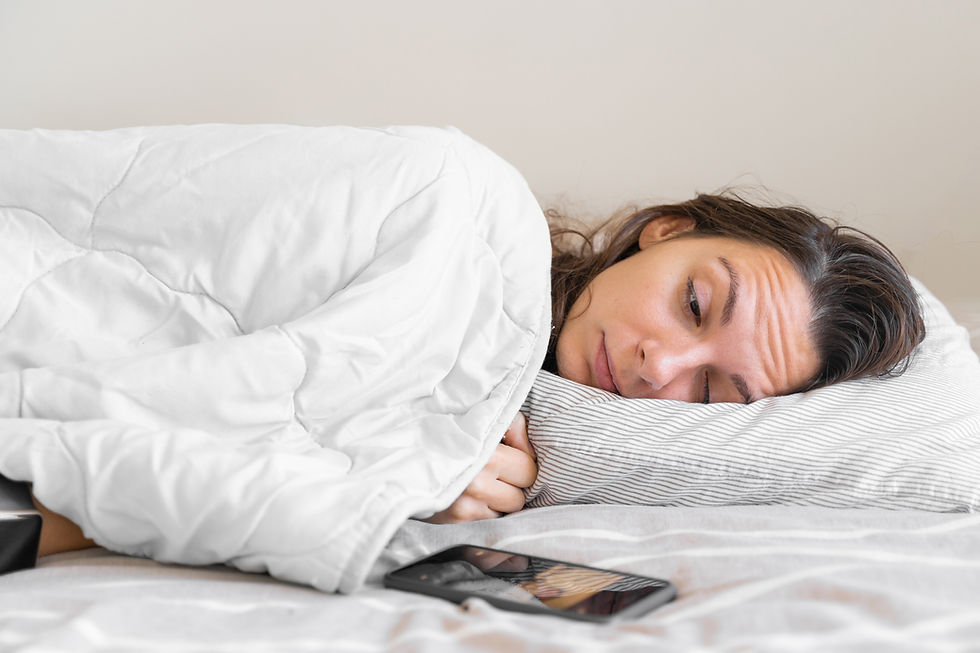
You've probably had this happen. You sleep about the same number of hours two nights in a row. But one morning you feel sharp and clear. The next morning, you feel foggy, as if you're walking through wet sand. Why?
Part of the answer involves the hormones cortisol and melatonin because they help regulate when your body feels awake and when it feels ready for sleep. But hormones are only part of the story. How well you slept through the night, how much “sleep pressure” had built up (the drive to sleep that grows the longer you're awake), and which sleep stage you woke from can all affect how alert you feel, too.
There's a lot of talk online about cortisol, and plenty of debate about whether to take melatonin supplements for sleep. So that's what we'll focus on here: what these two hormones do and where the science is solid versus still evolving.
Two Hormones, Two Signals, Different Jobs
Cortisol and melatonin follow different daily patterns, but both are coordinated by the brain's internal body clock, a small cluster of cells called the suprachiasmatic nucleus (SCN), tucked within a brain region called the hypothalamus. Think of the SCN as a conductor: it doesn't produce cortisol or melatonin, but it sends timing signals, through different pathways, that tell your adrenal glands when to release cortisol and your pineal gland when to release melatonin. Light is the strongest cue that keeps this clock on schedule, but sleep, activity, stress, illness, certain medications, age, and your personal chronotype (whether you're naturally more of a morning or evening person) can also nudge these rhythms.
Here's the basic pattern in a healthy rhythm:
● Cortisol is highest right around when you wake up. Then it slowly drops for the rest of the day.
● Melatonin stays low all day. It starts rising in the evening, a few hours before bedtime, and peaks overnight.
When this pattern is clear and steady, sleep tends to go smoothly. When it gets blurry, with cortisol remaining high at night or melatonin rising too late, sleep problems often follow.
Cortisol: More Than Just “The Stress Hormone”
Most people think of cortisol only as “the stress hormone,” but it does more than that. Its rise in the early morning helps prepare your body for the day by making energy available and getting your cardiovascular system ready to go. Researchers call this morning rise the cortisol awakening response, or CAR.
A quick, honest caveat
Here's where we want to be upfront about something. For years, many scientists believed CAR was a special cortisol spike caused specifically by waking up. But researchers have debated this for a long time.
In 2025, Klaas and colleagues tested this directly. They tracked cortisol continuously, not just with a few spot-check samples, in 201 healthy adults, monitoring levels before and after waking. The surprising result: cortisol rose at about the same rate before waking as after. Waking itself didn't seem to cause a sudden spike. Cortisol may simply have already been on its way up as part of the normal 24-hour rhythm.
A commentary on this study (Velazquez Sanchez & Dalley, 2025) suggests we should be cautious about using CAR by itself as a stress marker. The broader, well-established pattern that cortisol is higher in the morning and lower at night still holds. It's the idea of a special “waking spike” that's now in question.
The study also found big differences from person to person, some of which were tied to how long people slept and when they woke up. Worth noting: the researchers didn't test whether keeping the same wake-up time day after day actually makes cortisol patterns steadier over time; that's a reasonable next question, not yet a proven answer.
Melatonin: A Signal, Not a Sleeping Pill
A lot of people think melatonin knocks you out at night the way a sleep medication would. It doesn't work that way. The melatonin your body makes naturally mainly acts as a signal telling your body, “it's dark outside, nighttime has started.” It can make you feel sleepier, but it isn't a switch that flips you into sleep on its own.
Melatonin usually begins to rise about two hours before a person's normal bedtime. Researchers call this the dim-light melatonin onset, or DLMO. DLMO timing isn't the same for everyone. It can shift with age, chronotype, and light exposure. A 2023 review (Kennaway, 2023) analyzed DLMO data from 121 studies and confirmed that timing varies widely from person to person, based on factors such as age and whether someone is naturally an early bird or a night owl.
Light in the evening and at night can lower melatonin and shift your body clock later. Blue-toned light tends to have an especially strong effect, but how much it affects you depends on several factors: how bright the light is, how long you're exposed, how far you are from the source, what light you were exposed to earlier in the day, and your own sensitivity (Phillips et al., 2019; Giménez et al., 2022). Screens are a common source of this kind of light in the evening, but a brightly lit room can have a similar effect.
Quick Comparison
Cortisol | Melatonin | |
Made mainly by | Adrenal glands (small glands that sit on top of your kidneys) | Pineal gland (a small gland deep in the brain) |
Typical timing | Starts rising before you wake up, peaks in the early morning, then drops off in stages through the day | Rises once it gets dim, a few hours before bedtime; stays elevated through much of the night |
Main job | Boosts morning alertness; also helps regulate blood sugar, blood pressure, and immune activity | Signals that it's nighttime and supports the urge to sleep; helps keep the body clock on schedule |
Thrown off by | Irregular wake times, sleep timing, stress, activity, some medications | Shift work, evening light, age, some medications |
Common myth | It's only a "stress hormone," and any rise is harmful | It works like a sleeping pill |
Timing and Regularity Matter, Too — Not Just How Long You Sleep
Getting enough sleep matters, but total hours aren't the whole picture. When you sleep, how consistent your schedule is, how often you wake at night, how rested you feel, and how alert you are during the day all matter too (Sletten et al., 2023). A steady wake-up time helps keep cortisol on schedule. Consistent darkness in the evening helps keep melatonin on schedule. When someone's schedule is chaotic, shift workers are a classic example; both signals get thrown off. This is part of why “social jet lag” (staying up late and sleeping in on weekends, a concept we covered in Part 1) can leave people tired even when they technically get enough total sleep hours.
This is also why sleep advice that only talks about hours (“get 7 to 9 hours!”) tells just part of the story. Two people can sleep the exact same number of hours and have very different hormone patterns, depending on timing and other factors.
Where Yoga Practice Fits
This is where the timing of a yoga practice becomes genuinely useful.
Morning practice
A steady morning routine can help keep your sleep-wake schedule on track. Morning light is the strongest cue in this system, and movement may provide an extra nudge in the same direction. A morning yoga practice can be a practical way to pair regular movement with outdoor or bright light, though we don't yet have direct evidence that morning yoga specifically “normalizes” cortisol. Think of it as a helpful habit, not a proven hormone fix.
Evening practice
Calming evening practices may help some people feel more relaxed or sleep better, but solid evidence for a specific hormone-based cause remains limited. A small study by Tooley and colleagues (2000) found a short-term increase in nighttime melatonin after meditation. A more recent study (Moszeik et al., 2025) found that people practicing online Yoga Nidra had lower cortisol and better well-being. These results are encouraging, but the studies are small, and we don't yet fully understand the mechanism. We'd call this a promising, evidence-informed idea; not a proven fact.
The Bottom Line
Cortisol and melatonin are useful clues to how your body clock is running, but they're not the whole sleep story. Healthy sleep depends on more than one factor: how long you sleep, when you sleep, how consistent your schedule is, how much light you get and when, how well you stay asleep, and your natural chronotype. Yoga can be one helpful tool in that mix, for relaxation, movement, and building a steady routine.
Want to learn more? Consider joining us for Better Sleep, Better Outcomes: Evidence-Informed Approaches for Rehabilitation Professionals, December 4–6, 2026 at The Landgrove, in Landgrove, Vermont.
References
Giménez, M. C., Stefani, O., Cajochen, C., Lang, D., Deuring, G., & Schlangen, L. J. M. (2022). Predicting melatonin suppression by light in humans: Unifying photoreceptor-based equivalent daylight illuminances, spectral composition, timing and duration of light exposure. Journal of Pineal Research, 72(2), e12786. https://doi.org/10.1111/jpi.12786
Kennaway, D. J. (2023). The dim light melatonin onset across ages, methodologies, and sex and its relationship with morningness/eveningness. Sleep, 46(5), zsad033. https://doi.org/10.1093/sleep/zsad033
Klaas, S., Upton, T. J., Zavala, E., et al. (2025). Awakening not associated with an increased rate of cortisol secretion. Proceedings of the Royal Society B: Biological Sciences, 292(2038), 20241844. https://doi.org/10.1098/rspb.2024.1844
Moszeik, E. N., Rohleder, N., & Renner, K. H. (2025). The effects of an online Yoga Nidra meditation on subjective well-being and diurnal salivary cortisol: A randomised controlled trial. Stress and Health, 41(3), e70049. https://doi.org/10.1002/smi.70049
Phillips, A. J. K., Vidafar, P., Burns, A. C., McGlashan, E. M., Anderson, C., Rajaratnam, S. M. W., Lockley, S. W., & Cain, S. W. (2019). High sensitivity and interindividual variability in the response of the human circadian system to evening light. Proceedings of the National Academy of Sciences, 116(24), 12019–12024. https://doi.org/10.1073/pnas.1901824116
Sletten, T. L., Weaver, M. D., Foster, R. G., et al. (2023). The importance of sleep regularity: A consensus statement of the National Sleep Foundation sleep timing and variability panel. Sleep Health, 9(6), 801–820. https://doi.org/10.1016/j.sleh.2023.07.016
Stalder, T., Oster, H., Abelson, J. L., Huthsteiner, K., Klucken, T., & Clow, A. (2025). The cortisol awakening response: Regulation and functional significance. Endocrine Reviews, 46(1), 43–59. https://doi.org/10.1210/endrev/bnae024
Tooley, G. A., Armstrong, S. M., Norman, T. R., & Sali, A. (2000). Acute increases in night-time plasma melatonin levels following a period of meditation. Biological Psychology, 53(1), 69–78. https://doi.org/10.1016/S0301-0511(00)00054-1
Velazquez Sanchez, C., & Dalley, J. W. (2025). The cortisol awakening response: Fact or fiction? Brain and Neuroscience Advances, 9, 23982128251327712. https://doi.org/10.1177/23982128251327712


Comments